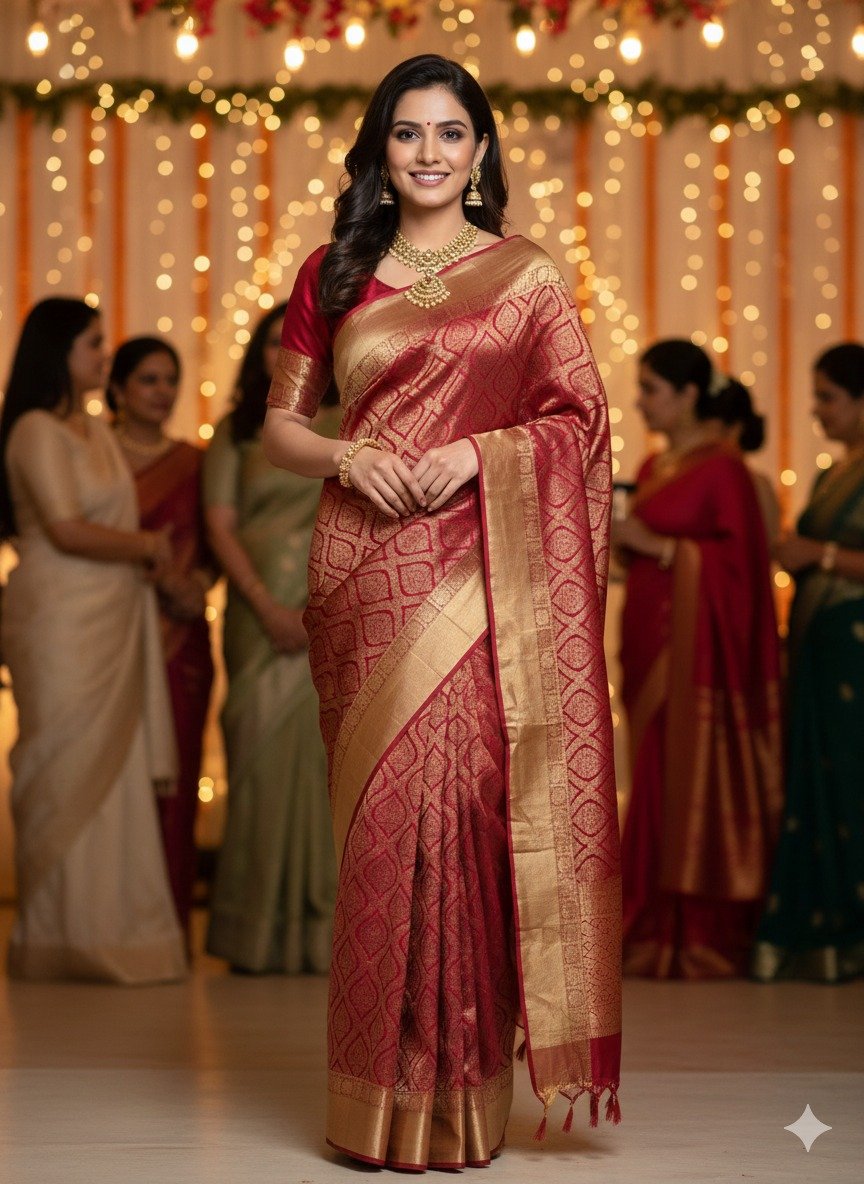
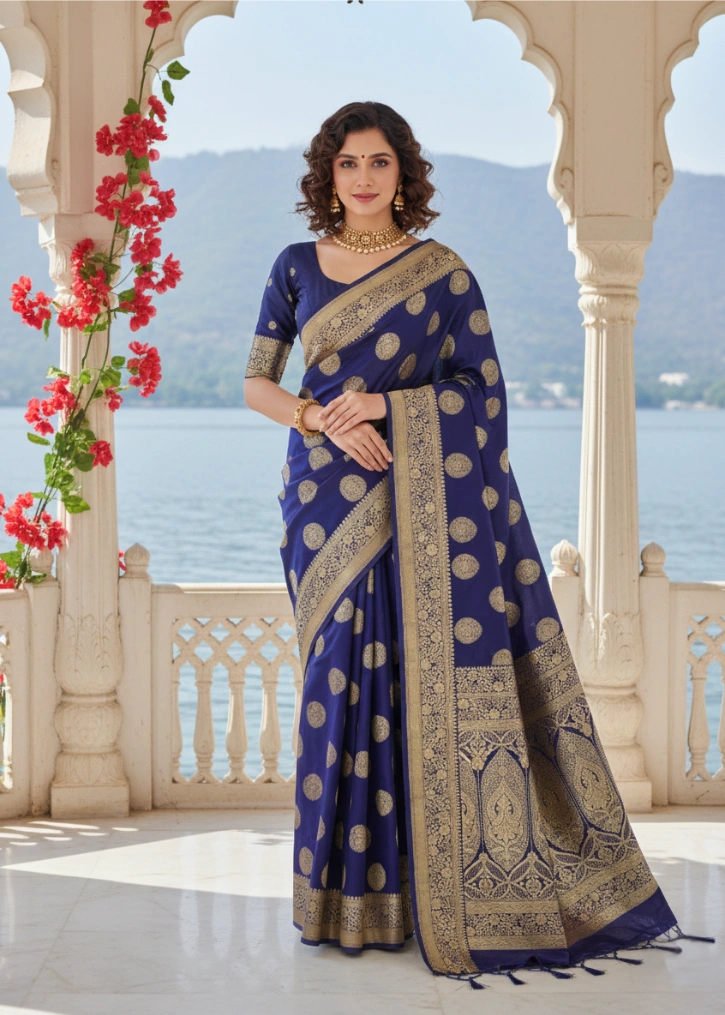
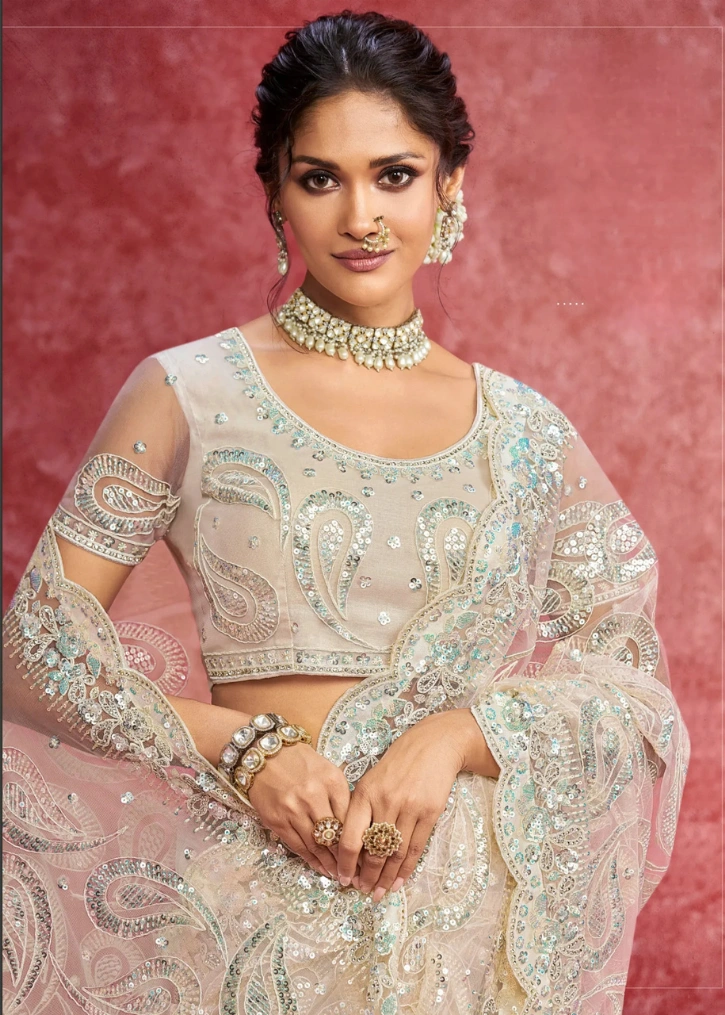
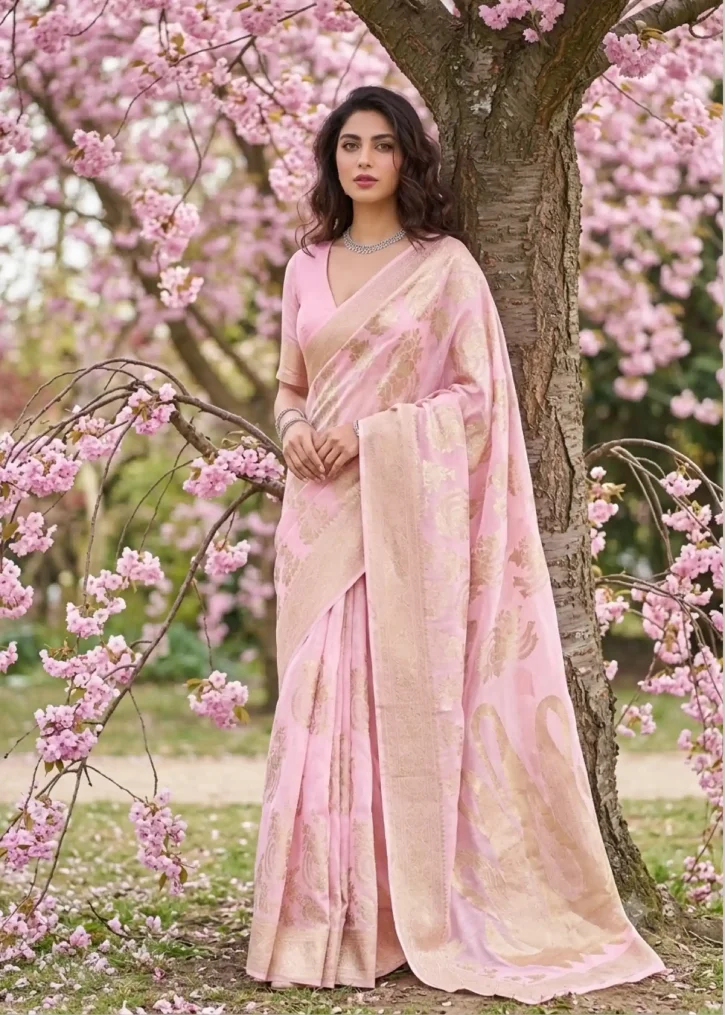
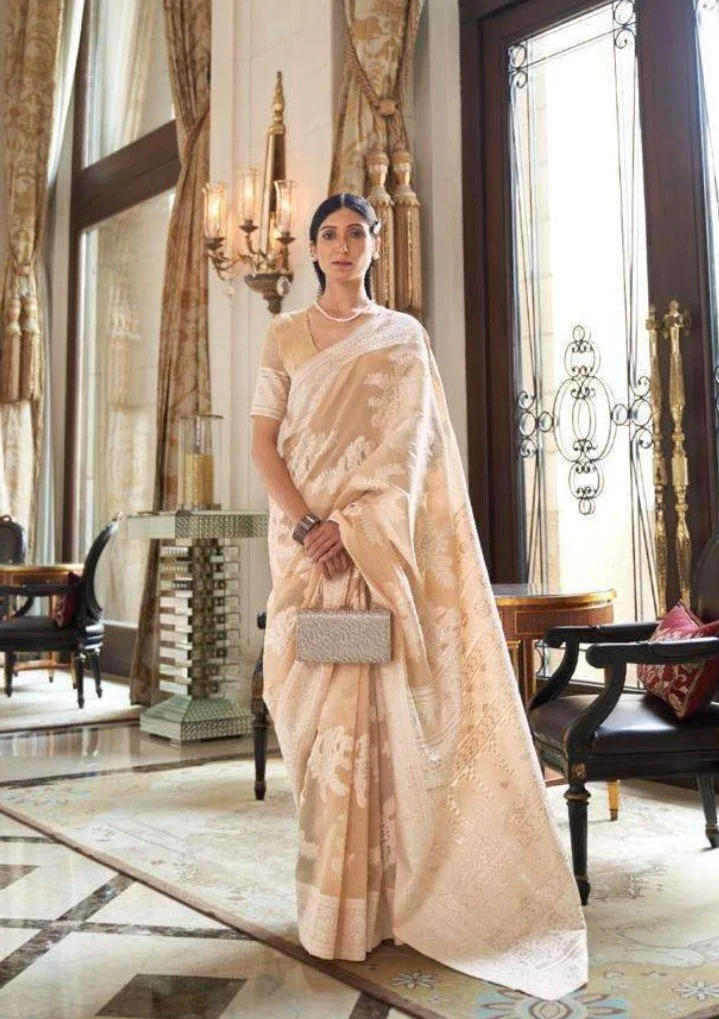
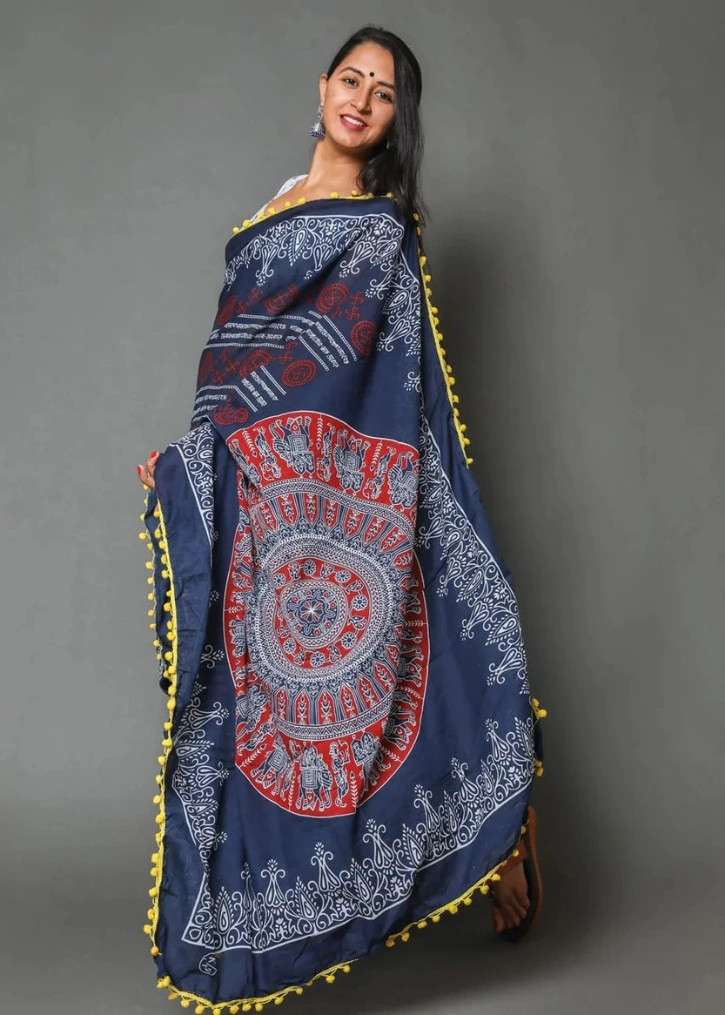
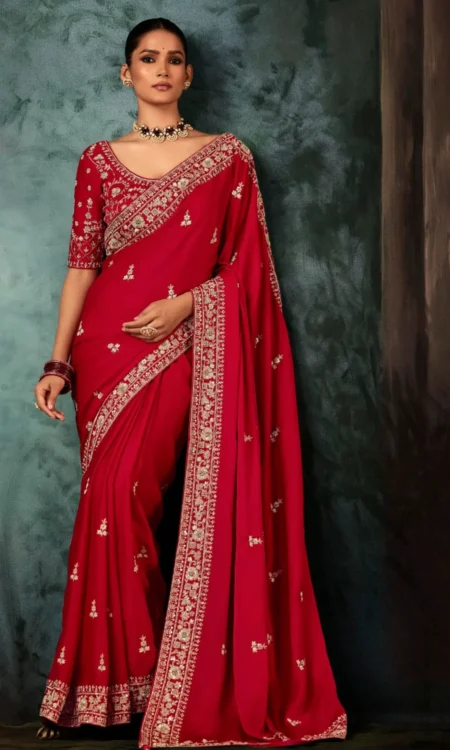
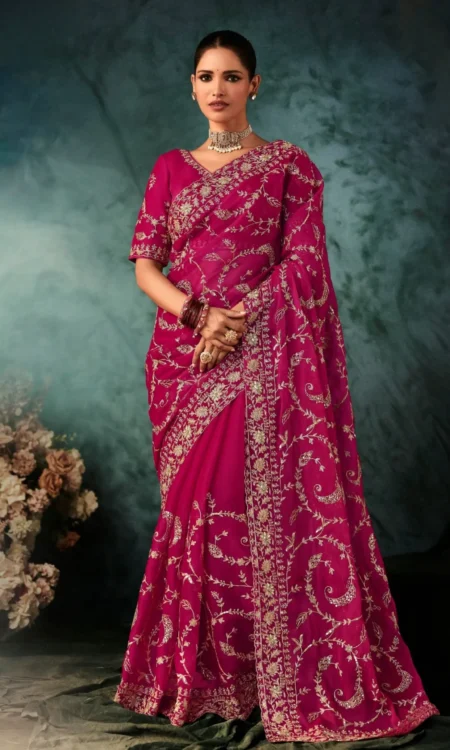
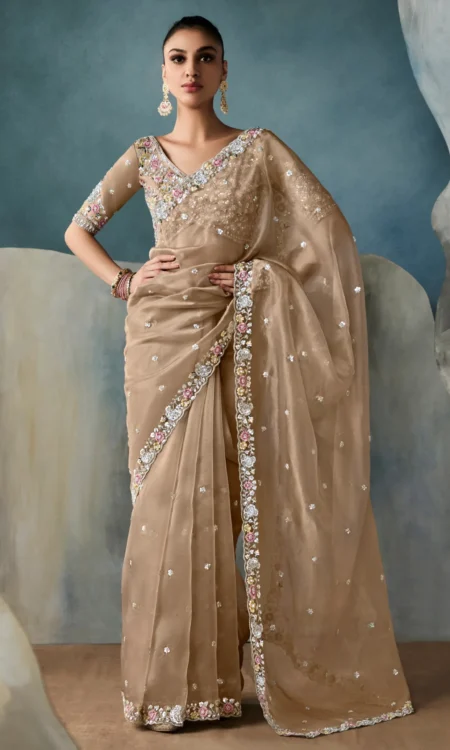
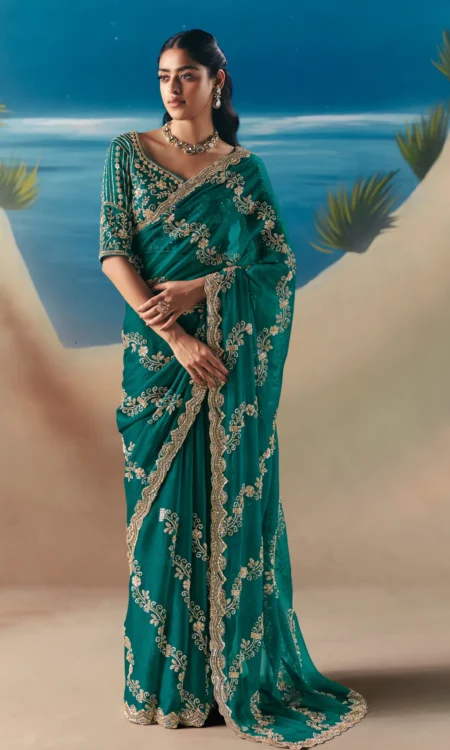
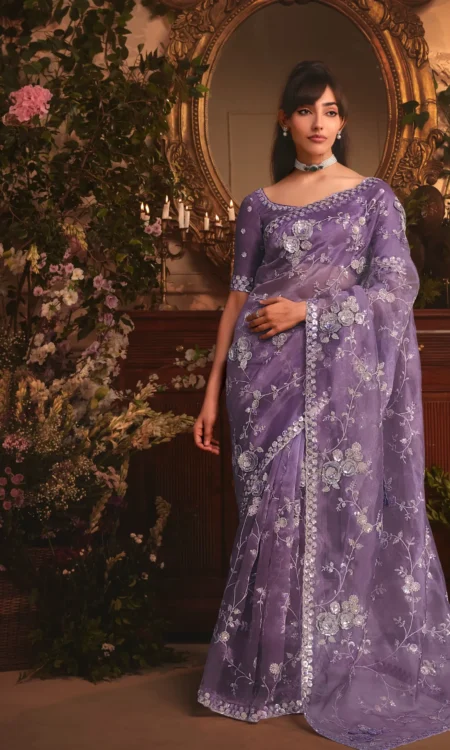
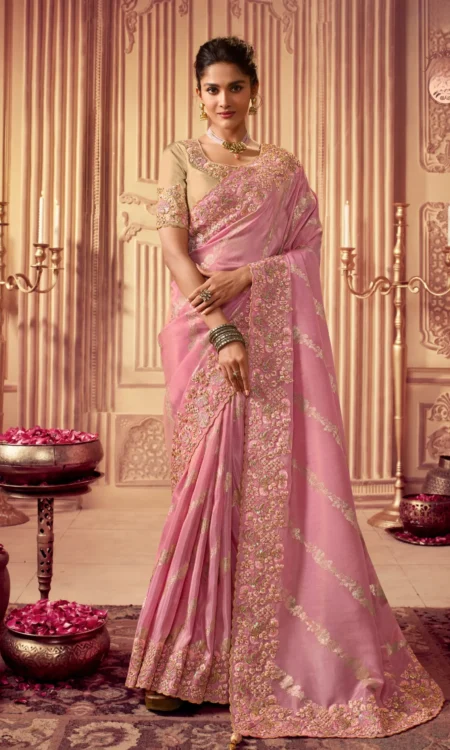
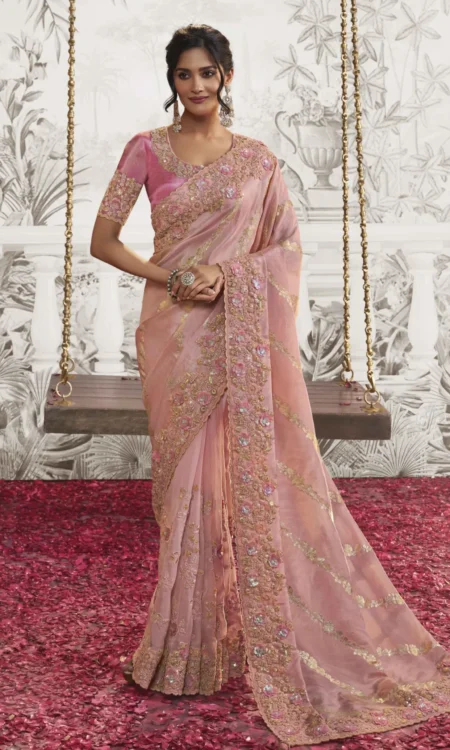
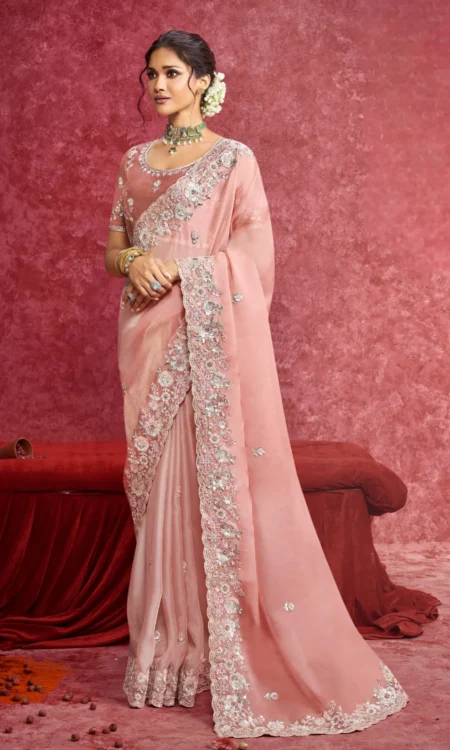
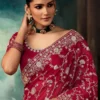
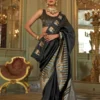
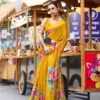
What Are Organza Sarees?
An organza saree is a saree made using organza fabric, a fine, sheer woven fabric generally recognized for its crisp hand, transparency and structured appearance.
Organza is a
fabric category, not a synonym for silk. Silk organza uses silk fiber, while other organza fabrics may use manufactured fibers such as polyester or nylon. This means two organza sarees can look similar while differing in composition, hand feel, sheen, weight, drape and care requirements.
The saree's finished character also depends on what has been added to the fabric. Embroidery, sequins, zari, borders and other embellishments can change its visual weight and the way it drapes.
What Is Organza Fabric?
Organza is traditionally associated with silk and is also produced using manufactured fibers. It is generally a plain-weave fabric made with fine filament yarns, with yarn characteristics and finishing contributing to its characteristic crisp and sheer quality.
For shoppers, the important distinction is simple:
Organza describes the fabric and its construction; silk, polyester and nylon describe fiber composition.
So:
- Silk organza = organza made with silk fiber
- Polyester organza = organza made with polyester
- Nylon organza = organza made with nylon
- Blended organza = organza made using more than one fiber
Not every saree described as organza should therefore be assumed to be silk.
Why Is Organza Crisp and Structured?
Organza is generally associated with a crisp, slightly firm hand rather than the highly fluid fall of fabrics such as chiffon.
Its characteristic behavior is influenced by its fine yarns, plain-weave construction, yarn twist and finishing. These factors help give organza its combination of sheerness and body.
This structure can make organza particularly appealing when you want:
- Defined pleats
- A pallu with visible body
- A polished silhouette
- More shape than a highly fluid sheer
- A delicate, translucent appearance without losing structure
However, not every organza saree feels equally firm. Fiber, yarn construction, density and finishing can all affect the final hand.
How Sheer Is an Organza Saree?
Organza is generally sheer or translucent, but the exact level of transparency can vary.
Factors that can affect how transparent a saree appears include:
- Fiber composition
- Yarn fineness
- Fabric density
- Color
- Finishing
- Embroidery
- Sequins or other embellishment
- Layering and styling
For this reason, do not judge transparency from the word "organza" alone.
When choosing a saree, look closely at product photographs and fabric close-ups where available. Also consider how the saree will be layered and what blouse or petticoat combination you plan to wear.
Is Organza Always Silk?
No.
Organza is not automatically silk. It is a fabric category that can be produced using silk as well as manufactured fibers such as polyester and nylon.
A saree should be described as silk organza only when its product information establishes silk composition.
This distinction is particularly important when shopping online because a product title may contain wording such as "organza silk" while the structured material information may use the broader term "organza."
Always check the individual product details when fiber composition matters to your purchase.
Silk Organza vs Synthetic Organza
Silk organza and synthetic organza can both provide the characteristic transparency and structured appearance associated with organza, but their fiber composition is different.
| Feature |
Silk Organza |
Synthetic Organza |
| Fiber |
Silk |
Manufactured fiber such as polyester or nylon |
| Fabric category |
Organza |
Organza |
| Appearance |
Can have a distinctive silk sheen |
Depends on fiber and finishing |
| Hand |
Can be crisp and delicate |
Can range from crisp to softer depending on quality |
| Drape |
Structured, with variation by quality |
Varies by fiber, yarn and finishing |
| Care |
Requires attention to product instructions |
Depends on fiber and product |
| Price |
Often influenced by silk content |
Often available at a wider range of price points |
Neither should be judged solely by the fiber name. Consider composition alongside fabric quality, finishing, embroidery, construction and the care required.
Organza vs Chiffon
Organza and chiffon can both be sheer and lightweight, but they generally create different effects.
| Feature |
Organza |
Chiffon |
| Hand |
Crisp and structured |
More fluid |
| Body |
More pronounced |
Softer, flowing fall |
| Drape |
Holds more shape |
Moves more freely |
| Surface |
Relatively smooth |
Often has a finer crepe-like character |
| Visual effect |
Airy with structure |
Airy with movement |
Choose organza when you prefer a more defined silhouette and choose chiffon when a softer, flowing drape is the priority.
Individual fabric qualities can vary, so product-specific information remains important.
Organza vs Georgette
Organza and georgette are both used for sarees, but their fabric behavior is noticeably different.
| Feature |
Organza |
Georgette |
| Surface |
Generally smooth |
More textured or crepe-like |
| Hand |
Crisp |
Dry/textured and more fluid |
| Structure |
More body |
More flowing |
| Drape |
Defined |
Fluid |
| Visual character |
Sheer and structured |
Sheer/lightweight with movement |
If you prefer a saree with more structure and visible pleat definition, organza may be the better fit. If you prefer fluid movement and a more textured surface, georgette may be more suitable.
Organza vs Crepe
Crepe is a broader fabric family rather than one single fabric construction, but many crepe fabrics are recognized by their textured or slightly crinkled surface and characteristic fall.
In simple shopping terms:
Organza: sheer + crisp + structured
Crepe: textured + varied + often more fluid
The exact feel of either fabric depends on its fiber, yarns, construction and finishing.
How to Choose an Organza Saree
The best organza saree depends on more than color or embellishment. Consider the following before purchasing.
1. Check the Composition
If fiber content matters to you, read the product's stated material information rather than assuming that every organza saree is silk.
2. Consider the Crispness
Some shoppers prefer organza for its structured character, while others may prefer a softer organza quality. Product descriptions and close-up photographs can help you assess the intended hand.
3. Look at Transparency
Check the fabric carefully, particularly if you prefer more coverage. Embroidery and embellishment can change how transparent different sections of the saree appear.
4. Consider Embellishment
Embroidery, sequins, Swarovski detailing and zari can add visual richness while also increasing the finished weight and affecting the drape.
5. Match the Occasion
A heavily embellished organza saree may work particularly well for parties, festive events or weddings, while a simpler design can create a more restrained look.
The occasion should be determined by the overall design, not by the word "organza" alone.
6. Examine the Border and Pallu
The border and pallu are important visual elements in an organza saree. Look for embroidered, zari or embellished details according to the level of formality you want.
7. Check the Blouse
Many sarees in the current collection include matching unstitched blouse pieces. Consider whether you want a coordinated blouse, a contrast blouse or a more contemporary design.
8. Consider Care Requirements
Embellished organza sarees can require careful handling. Read the individual product's care instructions before purchase.
Embroidered Organza Sarees
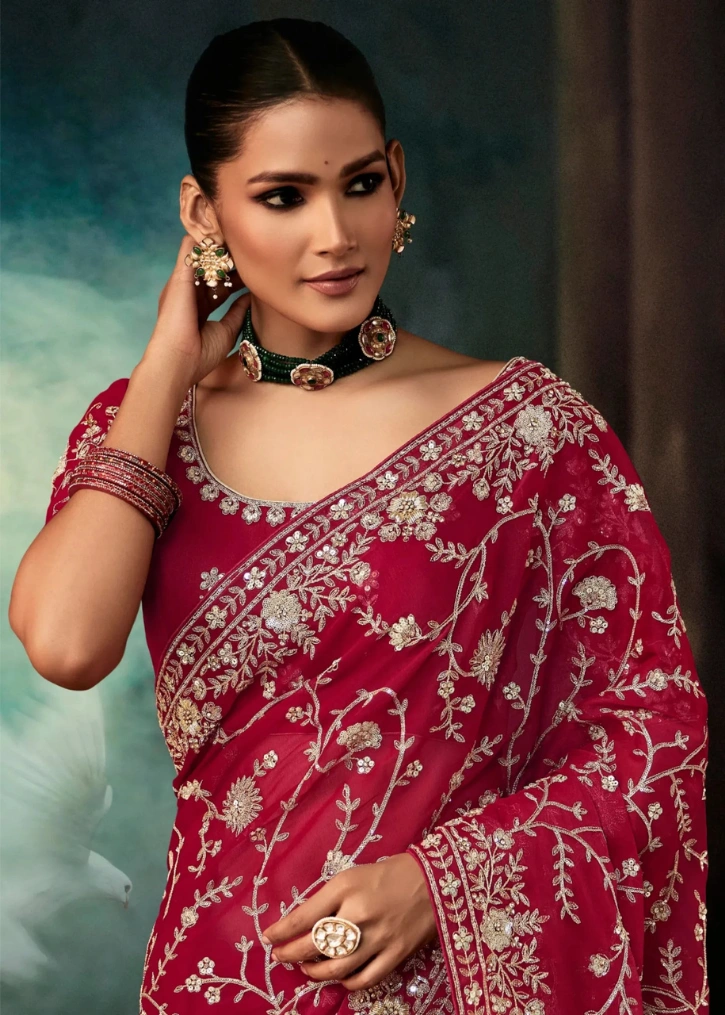
Embroidery is a prominent feature of the current collection.
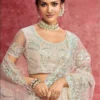
The range includes sarees with embroidered borders, embroidered pallus and floral detailing, alongside styles featuring sequins, Swarovski embellishment and zari.
Embroidery can change both the appearance and practical behavior of the saree. A heavily decorated saree may feel and drape differently from a minimally embellished organza saree.
When comparing styles, look at:
- Embroidery density
- Border width
- Pallu detailing
- Blouse embellishment
- Sequin or crystal placement
- Overall finished weight
Do not assume that embroidered means hand-embroidered unless the individual product description establishes it.
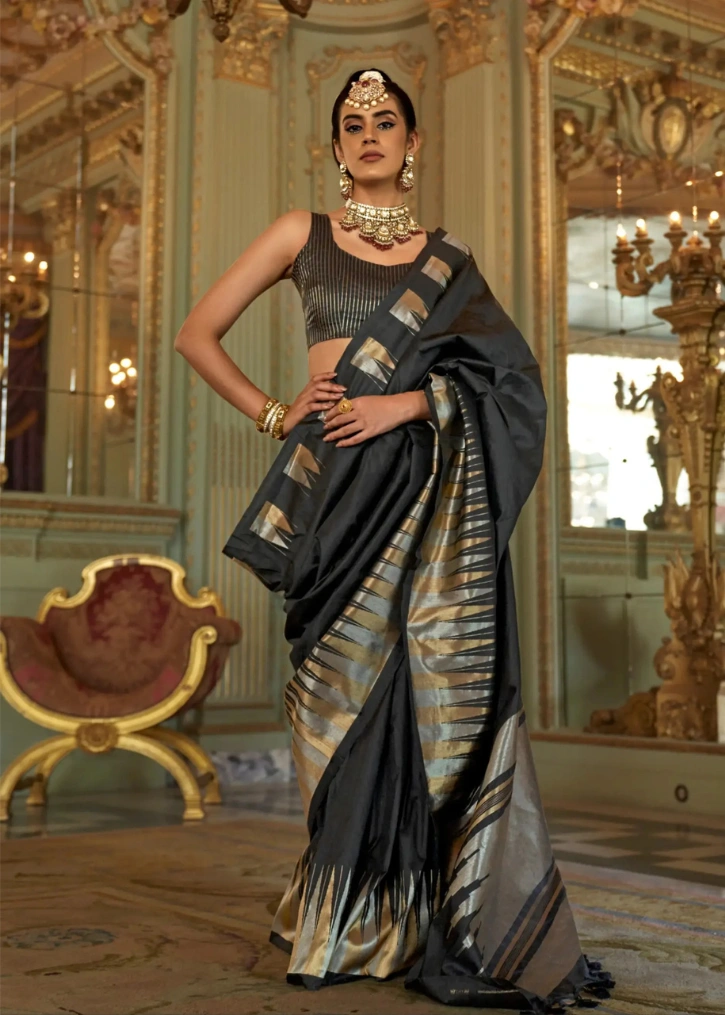
Organza Sarees with Zari
Zari detailing can add a metallic finish to an organza saree without making the fabric itself a different type of material.
The current collection includes styles with subtle zari borders and gold-toned detailing.
For a balanced look, consider the relationship between the zari, embroidery, blouse and jewelry rather than choosing accessories independently of the saree.
Organza Sarees with Floral Detailing
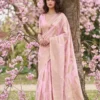
Floral decoration is represented in the current collection through embroidered floral elements and border detailing.
A floral organza saree can be styled in different ways depending on the density and scale of the design:
- Fine floral detailing for a restrained look
- Larger or denser embroidery for greater visual impact
- Embellished floral borders for formal occasions
- Coordinated floral blouse details for a more complete ensemble
The current collection is more strongly characterized by embroidered and embellished styles than by printed organza.
Organza Saree Borders and Pallus
The border and pallu can significantly influence the overall appearance of an organza saree.
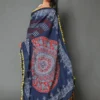
Current collection styles include embroidered borders, zari detailing and embellished pallus.
When shopping, consider:
- Whether the border is minimal or prominent
- How heavily the pallu is decorated
- Whether the pallu creates visual contrast
- Whether the blouse repeats the border or pallu detailing
- Whether the embellishment adds substantial weight
A statement pallu can become the focal point of the outfit, while a simpler border can create a more understated appearance.
Organza Sarees and Matching Blouses
Matching blouse pieces are available with several sarees in the current collection.
A matching blouse creates a coordinated appearance, while a contrast blouse can introduce another color or texture.
For embellished organza sarees, a relatively simple blouse can prevent the overall look from becoming visually crowded. With a simpler saree, a more detailed blouse can provide contrast.
The best choice depends on the saree's actual border, pallu and embellishment.
Are Organza Sarees Suitable for Weddings?
They can be.
Organza itself does not make a saree bridal or wedding-specific. Suitability depends on the overall design.
For a wedding or wedding-related event, consider:
- Embroidery
- Zari
- Sequins
- Border treatment
- Pallu detailing
- Color
- Blouse design
- Overall level of embellishment
A heavily embellished organza saree can create a formal wedding look, while a simpler design may be better suited to a wedding guest or less formal celebration.
Are Organza Sarees Suitable for Parties?
Yes, depending on the design.
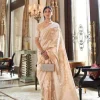
The current collection includes party-oriented styles with embroidery, sequins, Swarovski detailing and decorative borders.
For a party look, you can coordinate the saree with:
- Statement earrings
- A structured clutch
- Metallic accessories
- A coordinated or contrasting blouse
Let the level of embellishment determine how much additional jewelry you need.
Can You Wear an Organza Saree to the Office?
Some organza sarees can work for office settings, but the choice should depend on workplace expectations and the individual saree.
For a more restrained office look, consider:
- Subtle colors
- Minimal embellishment
- Less prominent borders
- Controlled transparency
- A simple blouse
- Restrained jewelry
Highly embellished or heavily sequined organza sarees are generally better reserved for more formal or celebratory occasions.
How to Style an Organza Saree
Organza's structured character can be emphasized through a clean, defined drape.
For a refined look
Choose a coordinated blouse, understated jewelry and a neat pleated drape.
For a festive look
Pair embroidered or zari-detailed organza with statement earrings and complementary accessories.
For a formal evening look
Use the pallu as the focal point and keep the remaining accessories proportionate to its embellishment.
For a contemporary look
Consider a modern blouse silhouette or a restrained jewelry combination while allowing the saree's structure and border to remain visible.
How to Choose Jewelry for an Organza Saree
The jewelry should respond to the saree rather than the fabric name alone.
For heavily embellished styles:
- Statement earrings can be enough
- Metallic accents can complement zari
- Avoid competing with a heavily decorated pallu
For simpler organza sarees:
- Delicate jewelry can keep the look refined
- A statement necklace can provide contrast
- Minimal accessories can emphasize the fabric's structure
Organza Sarees for the UAE
For shoppers in Dubai, Abu Dhabi, Sharjah and other parts of the UAE, consider the actual event environment when selecting an organza saree.
For air-conditioned indoor occasions, an embellished organza saree can be styled comfortably as part of a formal ensemble.
For outdoor events, consider transparency, layering, blouse coverage and the amount of embellishment.
It is better not to assume that every organza saree is automatically breathable or cooling. Those characteristics depend on fiber, construction, finishing and garment design.
How to Check Organza Saree Quality
Before purchasing, consider several signals together rather than relying on one visual clue.
Check the composition
Look for the stated fiber content.
Examine the fabric
Look at the surface, transparency, consistency and overall finish.
Assess the hand and structure
A good product description should help establish whether the specific saree is intended to feel soft, crisp or structured.
Inspect the embroidery
Look at stitch consistency, density, border finishing and embellishment placement.
Examine the pallu
The pallu is often one of the most detailed parts of an embellished saree.
Check the blouse
If a blouse piece is included, consider its fabric, embellishment and coordination with the saree.
Review care instructions
A delicate embellished saree may require substantially more care than a simpler design.
No single visual characteristic can independently prove the quality, authenticity or fiber composition of an organza saree.
How Heavy Is an Organza Saree?
Organza fabric is generally lightweight, but the finished saree can weigh considerably more depending on its construction and embellishment.
Embroidery, sequins, Swarovski elements, zari and substantial borders can all add weight.
The current Organza collection includes products with listed weights of approximately 700 g, 800 g and 900 g, demonstrating why the finished garment should not be described simply as "ultra-lightweight."
If finished weight matters to you, check the individual product information.
Organza Saree Care Guide
Always follow the care instructions supplied with the individual saree first.
For the current Sarees By Muhurat collection, product care guidance emphasizes professional dry cleaning and careful handling, including avoiding harsh cleaning methods, twisting, squeezing, brushing or beating the saree.
For embellished pieces, additional care is particularly important around embroidery, zari, sequins and other decorative elements.
Storage
Store the saree in a clean, dry and airy environment. Avoid unnecessary pressure on embellishment and change folds periodically when appropriate.
Heat
Avoid extreme direct heat and do not apply an iron directly over delicate folds, embroidery or embellishment unless the product's care instructions specifically permit it.
Because organza products can differ in fiber and embellishment,
product-specific care instructions should always take priority over a universal organza washing rule.
Frequently Asked Questions
What is an organza saree?
An organza saree is a saree made from organza, a fine, sheer woven fabric generally known for its crisp hand, transparency and structured character.
Is organza always silk?
No. Organza can be made from silk or manufactured fibers such as polyester and nylon. Silk organza specifically refers to organza made with silk fiber.
Is organza a fabric or a fiber?
Organza is a fabric category. Silk, polyester and nylon are examples of fibers that can be used to produce organza.
Is organza transparent?
Organza is generally sheer or translucent, although its exact transparency varies with fiber, yarn, fabric density, color, finishing and embellishment.
Is organza stiff?
Organza is characteristically crisp and structured, but individual qualities can feel softer or firmer depending on their fiber, yarn construction and finishing.
Why is organza crisp?
Its characteristic crispness is associated with its fine filament yarns, yarn twist, plain-weave construction and finishing.
Is organza lightweight?
The fabric is generally lightweight, but a finished organza saree can be substantially heavier when it includes embroidery, zari, sequins or other embellishment.
Does organza hold its shape?
Organza generally has more body and structure than highly fluid sheer fabrics, although the degree of shape retention varies by fabric quality and embellishment.
How does organza drape?
Organza generally creates a more structured drape with defined pleats and a pallu that can retain visible body. Its exact drape depends on the specific fabric and decoration.
What is silk organza?
Silk organza is organza made using silk fiber. It should not be confused with organza in general, because organza can also be made using manufactured fibers.
Can organza be synthetic?
Yes. Polyester and nylon are among the manufactured fibers that can be used to produce organza.
What is the difference between organza and chiffon?
Organza is generally crisper and more structured, while chiffon tends to provide a softer, more fluid drape.
What is the difference between organza and georgette?
Organza generally has a smoother, crisper and more structured character, while georgette is typically more textured and fluid.
What is the difference between organza and crepe?
Organza is associated with sheerness, crispness and structure. Crepe is a broader family of fabrics often recognized by a textured or crinkled surface and varied drape.
Are organza sarees good for weddings?
They can be. Wedding suitability depends on the saree's embroidery, zari, embellishment, color, pallu, border and blouse rather than on organza alone.
Are organza sarees good for parties?
Yes, particularly when the saree features sequins, Swarovski detailing, embroidery, zari or a statement border.
Can organza sarees be worn to the office?
Some simpler organza sarees can be styled for office settings, depending on workplace expectations, transparency, color and embellishment.
How do I choose an organza saree?
Consider composition, transparency, crispness, embellishment, border, pallu, blouse, color, occasion and care requirements.
How do I check organza saree quality?
Check the stated composition, fabric consistency, transparency, surface, hand, finishing, embroidery, border, pallu, blouse and care information. Do not rely on one visual clue alone.
How do I check whether an organza saree is silk?
Check the product's stated fiber composition rather than assuming that the word "organza silk" establishes 100% silk composition. Where relevant, look for appropriate silk certification or authentication.
How should I care for an organza saree?
Follow the individual product's care instructions. For the current collection, professional dry cleaning and careful handling are emphasized, particularly for embellished sarees.
How should I store an organza saree?
Store it in a clean, dry and airy environment, protect delicate embellishment and avoid unnecessary pressure or direct heat.
Explore Related Saree Collections
If you are comparing fabric characteristics, explore the relevant collections by their actual shopping intent:
For chiffon, georgette, crepe and other fabric-led categories, use their dedicated collection pages when available rather than treating them as subcategories of Organza Sarees.